Building the Intelligence on the Fly
By Robyn Haynes, MSc Artificial Intelligence · Published on
It’s exciting to be part of the Orman project. I’m a software engineer with a specialism in AI. My own work on detection of diseases using computer vision led me to work with the Orman team.
Part of what I hope to achieve is writing a regular dev blog to describe my work — the challenges, the highs and the lows of developing something that has not been seen before. I hope you enjoy what you read!
Our initial challenge was fairly simple (!) — to focus on tree species detection by using the latest architectures available from the Computer Vision field.
Our current focus, after preliminary testing, is to optimise the way we acquire and label data that can be used to speed up model development to achieve everything we’ve outlined in our About Us page.
Standard data labelling is the least exciting part of AI — it’s the laborious process of adding descriptive tags or annotations to raw data to teach the machines. This helps machine learning models understand and interpret the data. The more you do, the more accurate your model becomes, and arguably the more intelligent the outputs are, as more data is added to the models.
Practically, this means taking an image and drawing a box or polygon around the item you wish to label (in our case a tree!) and tagging it, by hand, as “sitka spruce”, “red oak”, “norway spruce” etc.
If you take an image like the one below, you can see just how tedious this task can become:
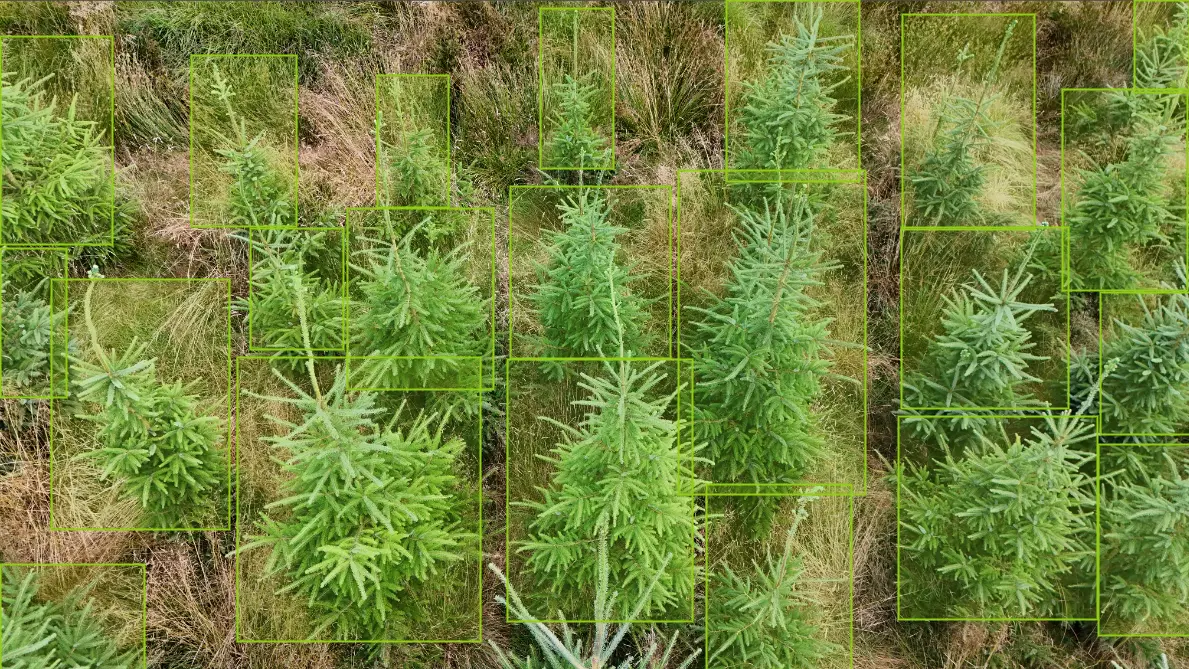
Figure 1: A Hand Labelled Image
Some of you may be familiar with a new term cropping up in AI — Agentic. Agentic refers to someone or something capable of achieving outcomes independently (“functioning like an agent”) or possessing such ability or power (having, if you like, “agency”). It’s especially used with a type of artificial intelligence (AI) — an AI agent — designed to execute complex tasks autonomously or with little human involvement.
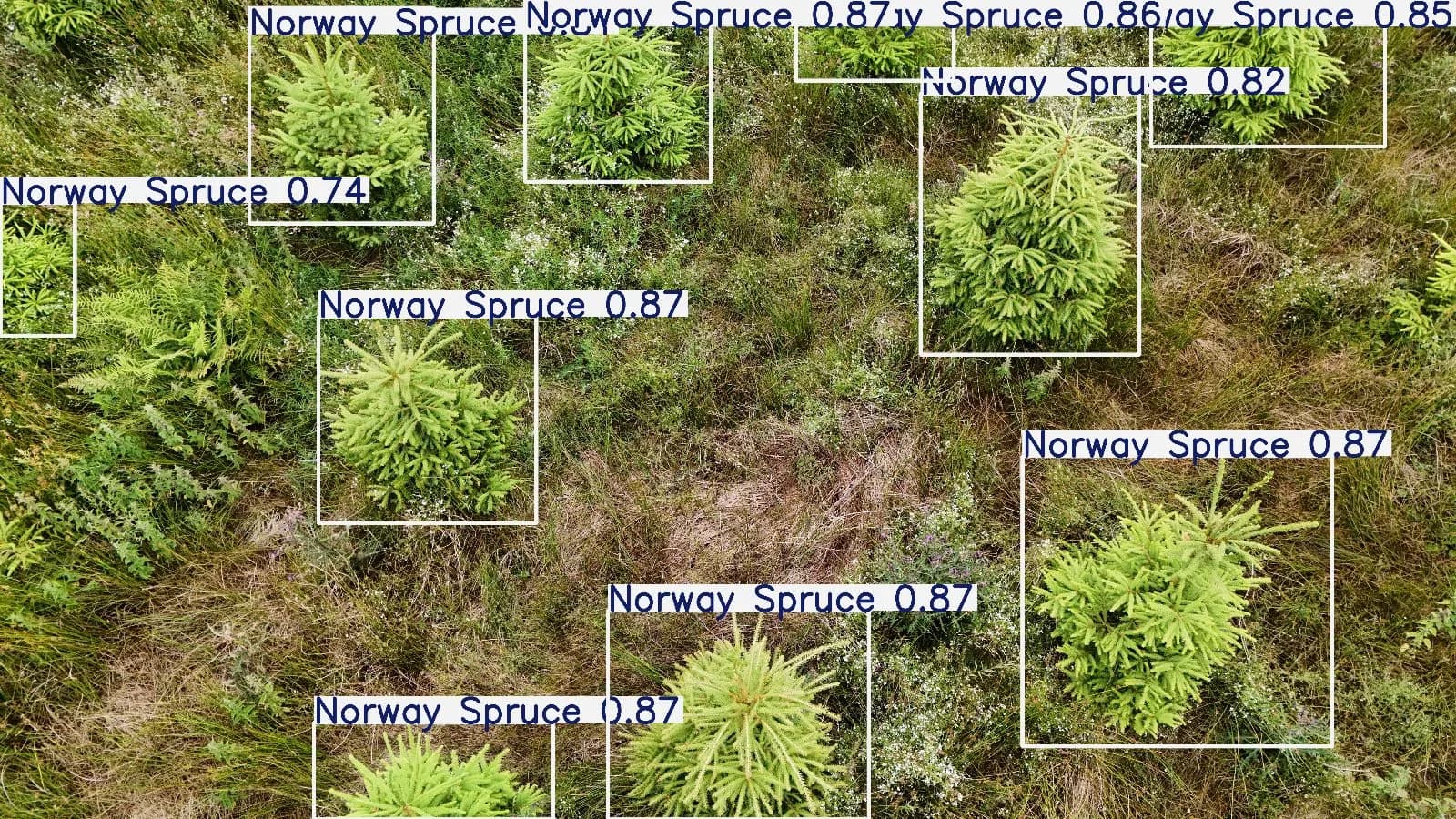
For Orman, that has meant much of my time recently has been spent auto-tagging images which are then simply checked or confirmed by one of our humans. The speed enhancements that can be created are huge — maybe 10 or even 20 times faster. This has been achieved with the creation of in-house tools to expedite the labelling process.
I have also spent time recently showing how video flypasts (which are after all just a quick series of changing images — fast enough to fool our eyes into thinking they are “movies”!) can be run through our early-stage models and identify species on the fly. An example video of the output is on the homepage of this website.
The next major challenge is to bundle everything up into an API service, where any company or individual can obtain access to our services and use them in their own projects — modifying it to fit their own needs, or just using our service as is. This flexibility is important as it’ll allow many people to expedite their developments so we can, together, address one of the largest challenges facing humanity today — that of climate change.
Practically, this means a drone pilot — flying a standard consumer drone — could, in theory, pass their video footage into Orman, and we could return a report on the species, its density, and any disease we can detect. As we add Lidar data into the mix, it will even be possible to give the literal weight of biomass and, if the data is collected annually, we’ll be able to see how much carbon is being stored!
Our ideas of what we’d like to achieve are vast, so a methodical approach to working through the key features we’re trying to deliver is a powerful way to keep our development concise, where each milestone holds a whole new feature to demonstrate — alongside progress as it matures.
For now, as we continue to work diligently to improve and expand our services, we hope that the current previews of our early work provide a clear glimpse of what we’re aiming to achieve and the overall utility of such a service.