
Innovation and Where to Find It
By Dr. Mark K. Smith · Published on
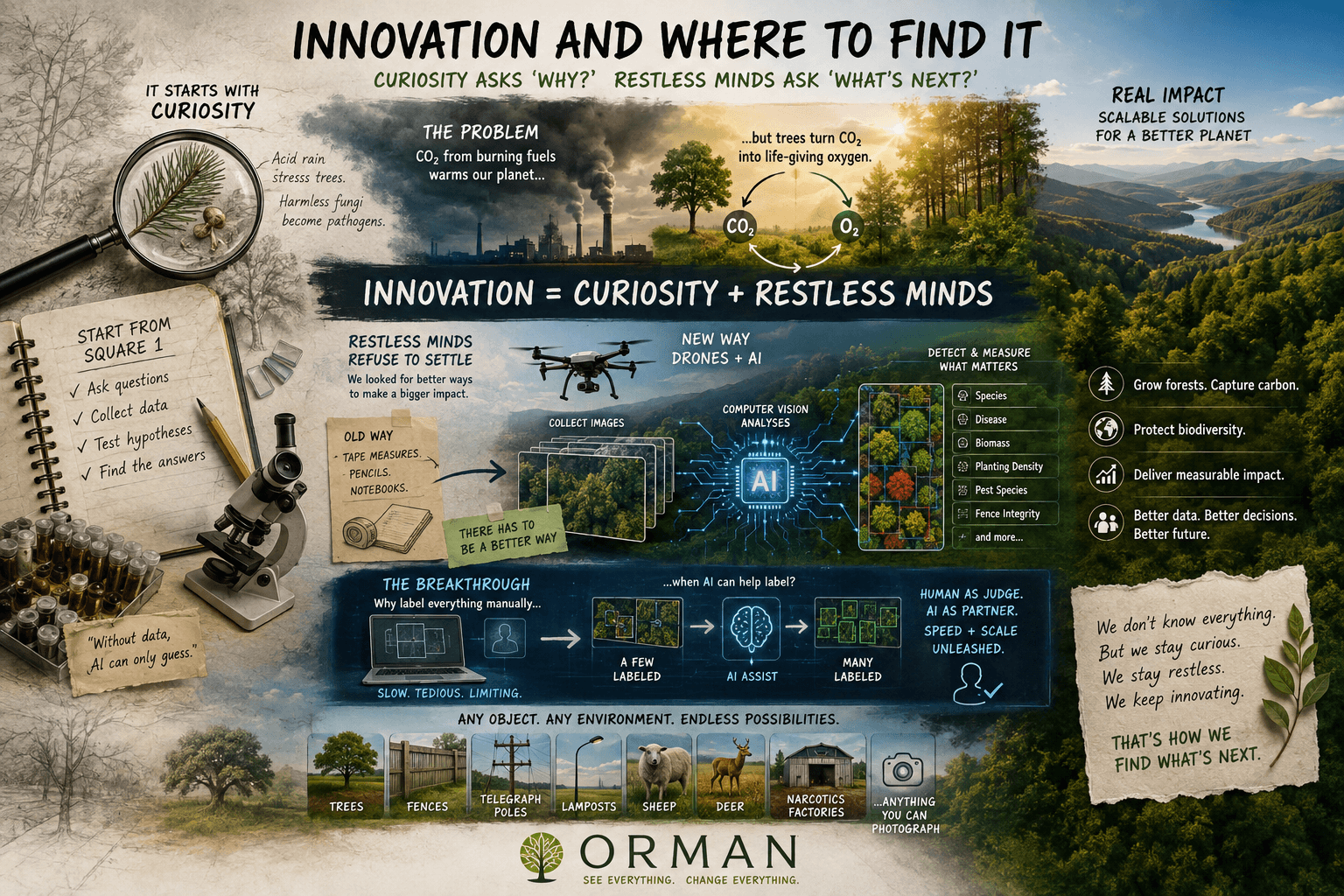
I have spent my entire career in a space people would call ‘innovation’. So over the summer, sitting on the unnaturally hot sands of a Cornish beach, I was musing what innovation actually means and how you might replicate it……
I reckon, in short summary, innovation is two things: curiosity and restless minds.
Let’s use Orman as a case study on how curiosity and restlessness might be applied.
Curiosity, and the Problem of Missing Data
Artificial Intelligence (AI) is a remarkable human advancement, bringing together a set of complex algorithms and sticking them on top of the sum of the knowledge of wo(man)kind (AKA the internet). This has resulted in a surge of possibilities, many of which were simply not thought about at its birth (Turing, A 1950). But here’s the thing — what if the data is simply absent? Ask an AI to opine on something where information is not available and, at best, the tech will probably make something up.
Hold that thought.
A Detour Through Acid Rain
Now very early in my career I was immersed in forestry – not literally, although I did spend an enormous amount of time in woodlands. My PhD was studying the impact of air pollution on commercial conifer plantations in the UK. So called ‘acid rain’ was killing forests in the UK and Europe and scientists were not at all sure what was causing it. My research, which appeared in the New Scientist of the time, suggested that one small factor was the turning of normally benign fungi, living harmlessly inside conifer’s needles, into nasty pathogens as air pollution stressed trees out and made them go bald.
I had no AI to turn to at the time, but then again, it would have been useless as I had to start from square 1 by collecting the original data — analysing 10s of 1000s of samples to test the hypothesis, which, I might add, is very dull indeed….. So even if AI was available, it would have been useless with the absence of data.
Roll forward some few decades (!) and I started to wonder if my early love of trees might benefit from what I learned about AI in my other, none forestry related, business interests.
Why Trees?
Now to curiosity – planting trees is simply one of the simplest and most efficient ways to deal with a warming planet. Carbon dioxide (CO₂), the by-product of burning hydrocarbons, leads to a hotter climate as we wrap ourselves in greenhouse gases. However, CO₂ is the key component of photosynthesis (with added sunlight) that plants (inc trees, of course) need to live – and their byproduct is literally the air we breathe. All the wonderful ‘carbon capture’ technologies that seek to hide CO₂ or make it into something else are just too insignificant compared to planting forests.
So, we have a problem. Where can tech play in the solution?
Restless Minds
That’s where restless minds come in. The one thing I have seen repeated, again and again in early-stage technology businesses, are people choosing a solution to a problem and stubbornly ignoring the evidence that they are wrong.
Orman’s original thought was to buy ‘cheap’ land and plant trees. Now this is lovely and more than possible, but the impact that would have is utterly trivial, globally speaking. So don’t be stubborn — move on.
Next up we studied the tech that was being applied to forestry, and that revealed a sector technologically miles behind. Woodland planted for carbon credits (one main motivator for much new woodland creation – whereby companies can pay for carbon capture by another company; ‘okay, I pollute so I spend £$++ paying to plant trees’) is monitored with tape measures, pencils and a notebook (not quite that bad, they might type up a report as well….!).
So, we thought, can we use images collected from drones flying over woodland, and apply computer vision (a subset of AI) to help calculate things like species, disease, biomass, planting density, pest species, fence integrity etc etc? The answer was ‘yes we can’ — so off we went for the best part of 2 years, collecting close to a third of a million images to create the data that AI needs to be, well, AI…
So That’s That Sorted Then? Well, No, Not Quite
What happens if you have a new problem? How long will it take to make the AI smart in solving that problem? Now that’s where restlessness and curiosity come back in.
In order to ‘label data’ (that’s the tedious part of AI that the press ignore – it’s the time it takes to teach the machines to be clever – think self-driving cars and the 100s of 1000s of objects they need to avoid hitting), Orman had to build its own labelling tool, and this is where gold turned out to be found.
‘Why not get the software to help with the labelling?’ we thought. So instead of drawing ‘bounding boxes’ around 1000’s of objects, maybe we could only label a few 100 and then ask the software to draw the bounding boxes for us and say what it ‘thinks’ the object actually is? The human operator is then moved from drawing boxes and choosing object names to being the judge on what the computer thinks — this is much, much faster and, lo and behold, we found ourselves in an altogether more interesting place.
Software that delivers the speed needed to take any object in the ‘field’ — be that a tree, a fence, a telegraph pole, a gantry, a lamppost, a sheep, a deer, an illegal narcotics factory, literally anything you can take a photo of — Orman can identify it automatically.
And now the only limit is your imagination.
Now, Will This Work?
Well, we reckon it will. We have a number of use cases being trialled and more in the pipeline, and if we’re wrong, we’ll change and adapt and be restlessly curious as to why!